
 The University
 Community
 Studies
 Services
 Research
 News
News Students
 Prospective Students
 Ionio.gr
A Workshop connecting cultural-heritage protection with financial crime, illicit trafficking and asset recovery at the 43rd Cambridge International Symposium on Economic Crime
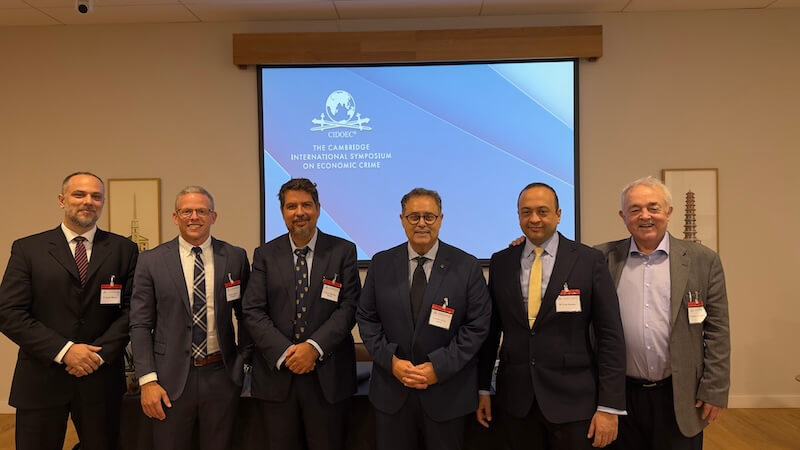
The UNESCO Chair on Threats to Cultural Heritage and Cultural Heritage-related Activities (TCHER) at the Ionian University successfully organised a Plenary Workshop, “UNESCO Chair on Threats to Cultural Heritage: Protecting Heritage from Financial Crime,” as part of the 43rd Cambridge International Symposium on Economic Crime.
Held at Jesus College, Cambridge, the Symposium took place from 23 to 30 August 2026 under the overarching theme “Asset Recovery and the Rule of Law: Taking the Profit Out of Crime.”
The workshop represented a historic milestone. It was the first workshop in the Symposium’s 43-year history to be organised by a UNESCO Chair and the first UNESCO-led session to place the protection of cultural heritage at the epicentre of the international economic-crime agenda.
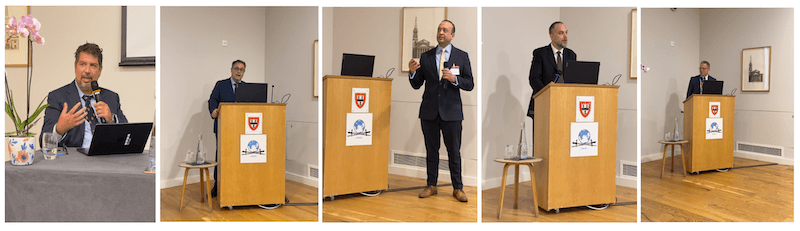
Chaired by Professor Dionysios Demetis, Professor of Information Systems at Hull University Business School (UK) research associate at MIT and a member of the UNESCO Chair, and Co-Chaired by Professor Stavros Katsios, Professor of International Economic Relations and International Economic Crime at the Ionian University (GR), visiting Professor at BLCU (CN) and holder of the UNESCO Chair, the workshop brought cultural-heritage specialists into direct dialogue with experts in financial crime, law enforcement, regulation, compliance and academia.
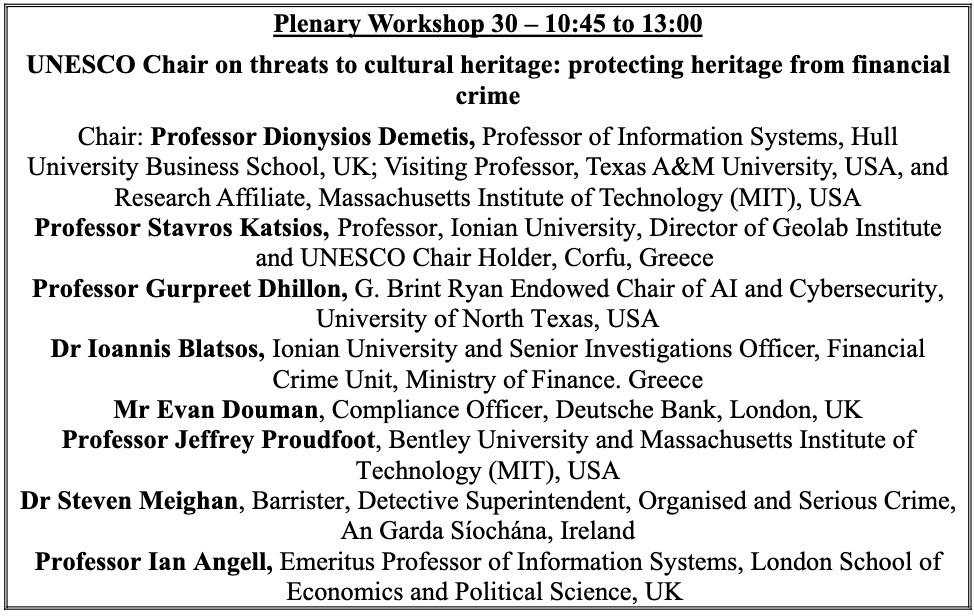
The session generated exceptional interest and sustained discussion, emerging as one of the standout workshops of this year’s programme. Its success demonstrated the growing international recognition that offences against cultural heritage cannot be treated solely as cultural or archaeological matters. The looting and illicit trafficking of cultural objects are closely connected with organised crime, corruption, money laundering, opaque ownership structures, fraudulent provenance, tax evasion and the movement of illicit financial assets across borders.
Participants examined the need to follow both the cultural object and the money. Particular emphasis was placed on provenance and traceability, the responsibilities of art-market participants and financial institutions, improved information sharing, the use of financial intelligence, the use of detection techniques and closer cooperation between cultural authorities, customs, police, prosecutors, researchers, practitioners and international organisations.
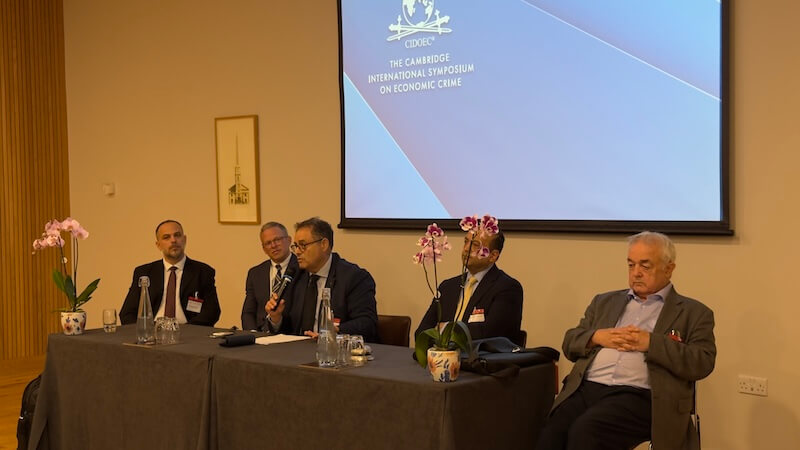
Cultural objects do not pass through illicit markets in isolation. They move through financial, corporate, commercial and increasingly digital infrastructures. Protecting cultural heritage therefore requires us to understand these systems, identify the profits generated by trafficking and bring cultural-property crime firmly within the international economic-crime and asset-recovery agenda. By bringing this discussion to Cambridge, the UNESCO Chair has opened an important new channel of cooperation between two professional communities that have too often worked separately. This historic first is not simply a symbolic achievement; it is the beginning of a practical and sustained dialogue.
The workshop also reinforced the importance of treating the recovery of stolen or unlawfully exported cultural objects as an integral component of asset-recovery policy. Effective action must address not only the return and restitution of the objects themselves, but also the criminal proceeds, facilitators and financial structures that enable illicit trafficking.
The UNESCO Chair on Threats to Cultural Heritage intends to build upon the workshop’s momentum through interdisciplinary research, professional training, policy dialogue and new partnerships linking the cultural-heritage and financial-crime communities.
The 43rd Cambridge International Symposium brought together experts and participants from more than 100 countries. Its programme comprised over 120 plenary sessions and workshops addressing the practical prevention and control of economically motivated crime.
ABOUT THE UNESCO CHAIR
The UNESCO Chair on Threats to Cultural Heritage and Cultural Heritage-related Activities at the Ionian University studies the environmental, economic, criminal, geopolitical, technological and other threats confronting cultural heritage. It promotes interdisciplinary research, education, capacity building, international cooperation and evidence-based policies for protecting cultural heritage for future generations.
Further information: https://unesco.ionio.gr
ABOUT THE CAMBRIDGE INTERNATIONAL SYMPOSIUM ON ECONOMIC CRIME
Established in 1982, the Cambridge International Symposium on Economic Crime is an internationally recognised forum for practical cooperation among representatives of government, law enforcement, the judiciary, regulatory and compliance bodies, the professions, business and academia.
Further information: https://www.crimesymposium.org

 Programme (in Greek)